



Software / SaaS / Tech
HubSpot That Scales With Your Product
Your platform evolves rapidly to meet market demands, but if your CRM architecture is rigid, your go-to-market teams will always be a step behind.
Book a Call
Vertical-Specific HubSpot Expertise
Most CRM Setups Can’t Handle SaaS Complexity
You have trials, freemium users, expansion opportunities, churn risks, and renewal cycles all running simultaneously.
And most HubSpot setups treat all of them the same way.
The result is a CRM that technically works but doesn't give your revenue team the visibility they need to win. A HubSpot portal built for SaaS, maps your full revenue motion into a single system that all of your teams can trust.
When your CRM reflects how your business actually generates revenue, your team stops working around it and starts working with it.
Certified HubSpot Experts
Here’s How We Build a High-Performing Portal, Together
Our team has completed HubSpot's most advanced technical and strategic training tracks.
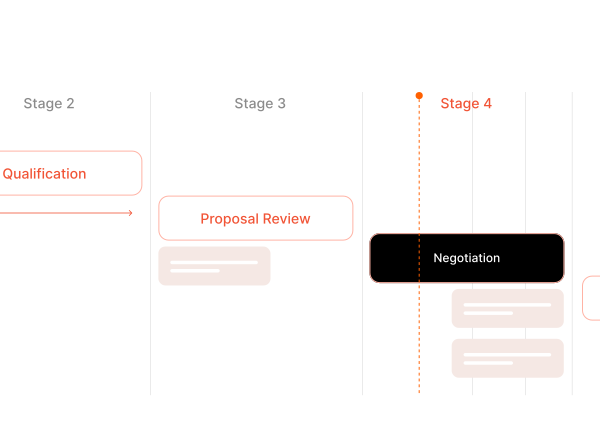
Step 01
Pipeline Architecture for Complex Revenue Models
We build pipeline stages that reflect your actual sales motion, not a generic template, so your team has accurate visibility at every stage.
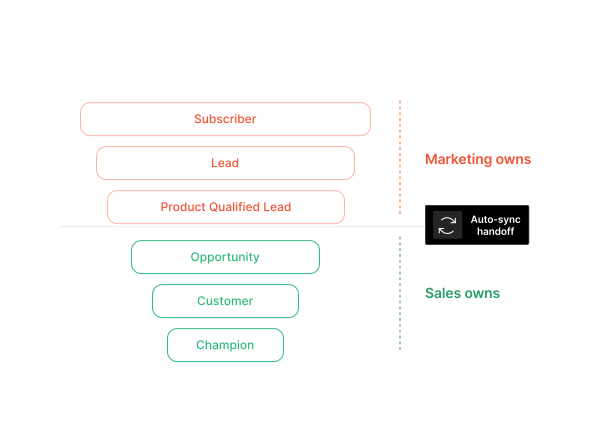
Step 02
Lifecycle Stage Configuration
We configure lifecycle stages that map to your product's user journey, so your marketing and sales teams are always in sync.
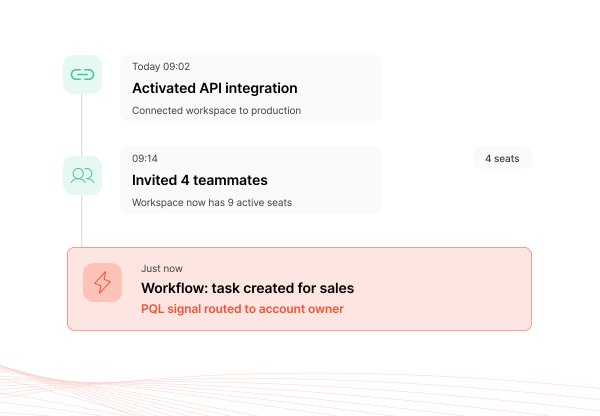
Step 03
Product-Led Growth Workflows
We build the integrations and automation that surface product signals in HubSpot so your sales team can act on them quickly.
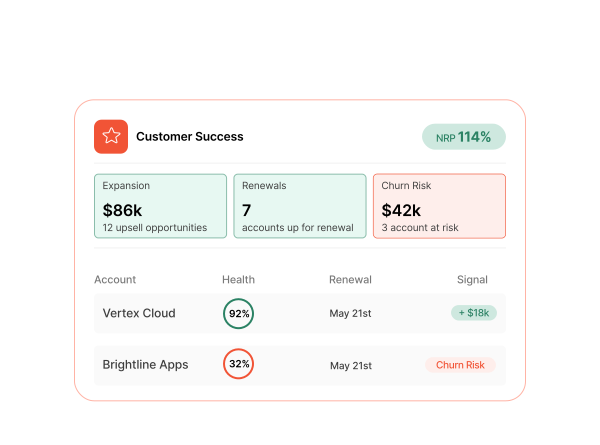
Step 04
Expansion and Retention Tracking
We configure HubSpot to give your customer success team visibility into expansion opportunities, renewal timelines, and churn risk.
Step 05
Revenue Reporting That Reflects Reality
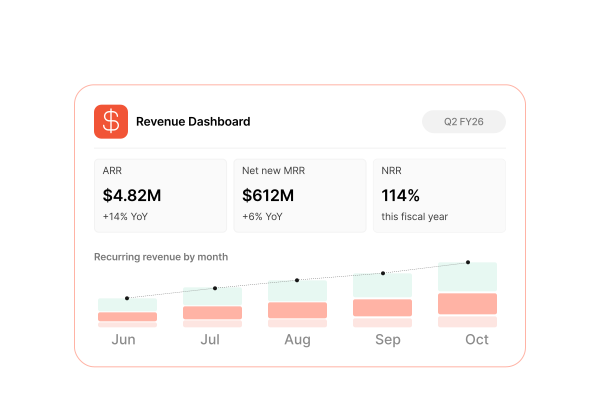
We build custom reports and dashboards that give your leadership team a clear picture of revenue health across the customer lifecycle.
Step 01
Pipeline Architecture for Complex Revenue Models
We build pipeline stages that reflect your actual sales motion, not a generic template, so your team has accurate visibility at every stage.
Step 02
Lifecycle Stage Configuration
We configure lifecycle stages that map to your product's user journey, so your marketing and sales teams are always in sync.
Step 03
Product-Led Growth Workflows
We build the integrations and automation that surface product signals in HubSpot so your sales team can act on them quickly.
Step 04
Expansion and Retention Tracking
We configure HubSpot to give your customer success team visibility into expansion opportunities, renewal timelines, and churn risk.
Step 05
Revenue Reporting That Reflects Reality
We build custom reports and dashboards that give your leadership team a clear picture of revenue health across the customer lifecycle.
HubSpot for SaaS Companies
What Changes When Your CRM Fits Your Revenue Model
A modern SaaS platform's HubSpot stack is the centralized nervous system for all customer interactions, providing a unified source of truth.
.wcrOZO5v.svg)
One Source of Truth Across the Entire Revenue Team
Pipeline, lifecycle stage, and customer health all live in one place. Your sales, marketing, and success teams can finally win together.

Early Warning on Expansion and Churn
Risk signals surface in HubSpot before they become emergencies. Your team sees the patterns early enough to act on them.

Shared Data, Shared Definitions
Every team is working from the same records and the same language. Handoffs stop breaking because the data is consistent.
.BqxvWk12.svg)
A Portal That Grows With You
Your HubSpot scales with your evolving go-to-market motion. Stop rebuilding from scratch every time your product or team changes.

Don't Just Take Our Word For It
SaaS Clients With Real Results
Partnering with Bryant Works was a game changer! Their expertise and strategic approach have been invaluable.
Valentina ArtunduagaCreative Operations Manager @ storyarb - CASE STUDY
- B2B Content Marketing
Revenue Reporting
Bryant Works' strategic implementation of HubSpot solutions transformed storyarb's operational capabilities, providing the tools and insights necessary for sustainable growth.
Read case studyBryant Works was the right choice. It's clear they actually care about setting you up for success.
Ellery FinkHead of Customer Experience @ Vori - CASE STUDY
- SAAS
HubSpot Customer Onboarding
Through thoughtful collaboration and expert implementation, Bryant Works helped Vori turn an underperforming HubSpot instance into a powerful onboarding engine.
Read case studyThe team was responsive, strategic, and genuinely easy to work with. Bryant Works helped us hit a critical milestone with confidence.
Kevin KeithVP of Sales & GTM Strategy @ RedBeam - CASE STUDY
- SAAS
Website Relaunch
From day one, Bryant Works prioritized alignment. The team didn't overcomplicate the process — they leaned into what mattered most: speed, quality, and communication.
Read case study


HubSpot Services for SaaS Companies
The most common engagements for software and technology companies:
HubSpot Implementations
Learn More
AI Agents & Automation
Learn More
Custom Builds
Learn More
HubSpot Integrations
Learn More




Next Steps
Make HubSpot Keep Up With Your Pipeline
Let's build a HubSpot portal that reflects your revenue model, scales with your growth, and gives your team the visibility they need to win.
FAQs About HubSpot Consulting

Is HubSpot a good CRM for SaaS companies?
Yes, particularly for SaaS companies with a defined sales motion, a marketing function, and a customer success team. HubSpot's flexibility makes it well-suited for the complexity of SaaS revenue models, including trials, freemium, expansion, and renewal cycles. The key is configuring it to reflect your specific revenue motion rather than using the default setup.
How is a HubSpot implementation for a SaaS company different from a standard setup?
A standard HubSpot setup is built around a simple linear sales process. SaaS revenue is more complex. You need pipeline stages that reflect your sales motion, lifecycle stages that map to your product's user journey, integrations with your product analytics and billing tools, and reporting that surfaces MRR, churn, and expansion alongside pipeline. A SaaS-specific implementation accounts for all of that from the start.
Can HubSpot handle product-led growth motions?
Yes, with the right configuration and integrations. Product usage data from your analytics platform can be surfaced in HubSpot through integrations, giving your sales team visibility into which free users or trial accounts are showing buying intent. We build these integrations as part of SaaS implementations where product-led growth is part of the revenue model.
How do you handle the complexity of SaaS pricing models in HubSpot?
SaaS pricing models, including tiered plans, usage-based billing, and annual vs. monthly subscriptions, can all be represented in HubSpot with the right custom properties, product catalog, and deal structures. We configure your deal and product library to reflect your actual pricing model so your pipeline data is accurate and your revenue reporting is meaningful.
Can HubSpot replace our customer success platform?
It depends on the complexity of your customer success motion. HubSpot's Service Hub can handle many customer success workflows, including renewal tracking, health scoring, and proactive outreach. For companies with more sophisticated CS operations, HubSpot often works alongside a dedicated CS platform like Gainsight or ChurnZero, connected through an integration. We assess what makes sense for your specific setup.
How do you integrate HubSpot with our product analytics tools?
We connect HubSpot to product analytics platforms like Mixpanel, Amplitude, Segment, and others through native integrations, middleware, or custom API builds depending on what your tool supports. The goal is to surface the product signals that matter to your sales and CS teams directly in HubSpot so they can act on them without switching platforms.
What does a HubSpot portal audit look like for a SaaS company?
We assess your current pipeline architecture, lifecycle stage configuration, automation logic, integration health, and reporting setup against your actual revenue model. Most SaaS portals we audit have significant gaps between how the CRM is configured and how the business actually operates. The audit surfaces those gaps and gives you a prioritized roadmap for closing them.
How long does a HubSpot implementation take for a SaaS company?
A full SaaS implementation, including pipeline architecture, lifecycle configuration, integrations, and reporting, typically takes 6 to 12 weeks. Simpler engagements focused on a specific area, like pipeline setup or a single integration, can move faster. We scope this during discovery.
Can you help us migrate from Salesforce to HubSpot?
Yes. Salesforce-to-HubSpot migrations are one of the most common engagements we handle for SaaS companies. We manage the full migration, including data cleanup, field mapping, custom object migration, and validation, so your team goes live on HubSpot with clean, trusted data.
What makes Bryant Works a strong HubSpot partner for SaaS companies specifically?
We have built and optimized HubSpot portals for software and technology companies across the full growth spectrum, from early-stage startups to scaling enterprise SaaS. We understand the revenue models, the go-to-market motions, and the reporting requirements that matter to SaaS leadership. We are also a HubSpot Diamond Solutions Partner with a 5.0 rating across hundreds of verified client reviews, which means the quality of our work is documented and verifiable.